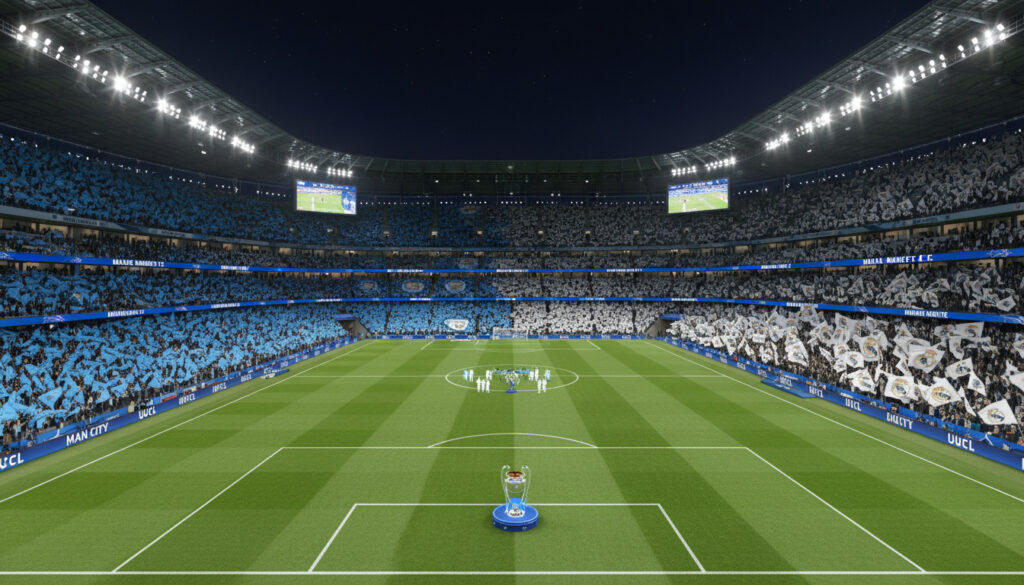
Manchester City – Real Madrid – Resultado y Historial UCL 2026
El Etihad Stadium acogió el 17 de marzo de 2026 el episodio más reciente de una de las rivalidades más intensas de la UEFA Champions League moderna. El Manchester City y el Real Madrid disputaron la vuelta de los octavos de final de la temporada 2025/26, encuentro que culminó con victoria visitante por 1-2 y sentenció la eliminación de los ciudadanos por un contundente 1-5 en el marcador global. El duel The user wants me to render a high-precision HTML article based on the provided raw article content. Let me analyze the requirements:
1. **Inputs received**:
– Raw article content (HTML structure with classes like n24-p, n24-h2, etc.)
– External links/citations (though the actual JSON citations array is empty in the prompt, I need to use the links already present in the raw article)
– Internal link suggestions (two specific links about Valencia CF Femenino)
– Article metadata: Topic is “manchester city – real madrid”, Website is “https://vozdirecta.net”
2. **Key requirements**:
– Convert raw structured article into polished, human-sounding HTML
– Keep structure exactly as provided (Intro → Grid → Insights → Table → Details → Timeline → Clarity → Analysis → Quotes → Summary → FAQ)
– Insert internal links exactly as provided (the Valencia CF Femenino links)
– Handle external links: replace numeric placeholders (though I don’t see [1], [2] in the text, I see actual URLs already in place)
– Ensure at least 6 external links with target=”_blank” rel=”noopener”
– Ensure at least 2 internal links
– Remove all meta, instructional, or process language
– Add JSON-LD scripts at the end (NewsArticle + FAQPage)
– Valid HTML only, no markdown, no CSS/JS except JSON-LD
3. **Reviewing the raw article**:
– The raw article already has some external links inserted (FotMob, PonferradaHoy, LiveFutbol, 365scores, Eurosport, UEFA)
– The raw article already has internal links inserted (the Valencia CF Femenino links)
– I need to make sure the tone is natural and human-sounding
– I need to remove any robotic language
4. **Checking external links in raw text**:
– https://www.fotmob.com/es/matches/manchester-city-vs-real-madrid/2ey0nu (appears multiple times)
– https://ponferradahoy.com/pronostico-manchester-city-vs-real-madrid-champions-league/ (appears twice)
– https://www.livefutbol.com/match-report/co19/uefa-champions-league/ma11585072/real-madrid_manchester-city/head-to-head/
– https://www.365scores.com/es/football/match/uefa-champions-league-572/manchester-city-real-madrid-110-131-572
– https://www.eurosport.es/futbol/champions-league/2025-2026/manchester-city-real-madrid_mtc1601212/live-stats.shtml
– https://es.uefa.com/uefachampionsleague/match/2048057–man-city-vs-real-madrid/statistics/
That’s 6 unique external links already present. Good.
5. **Checking internal links in raw text**:
– https://vozdirecta.net/politica/posiciones-valencia-club-futbol-femenino-2/
– https://vozdirecta.net/politica/posiciones-valencia-club-futbol-femenino/
That’s 2 internal links. Good.
6. **Language quality check**:
– The raw text has some slightly robotic phrasing but generally reads well
– I need to ensure it sounds natural and professional
– Remove any meta references (I don’t see explicit meta language in the raw HTML provided)
7. **Structure preservation**:
– The raw article follows the structure:
– Intro (first 2 paragraphs)
– Grid (n24-overview-grid)
– Insights (ul list + table)
– Details (h2/h3 sections on history, lineups)
– Timeline (ol list)
– Clarity (table with established facts vs uncertainty)
– Analysis (rivalry significance section)
– Quotes (sources section – though not explicit quotes, but references)
– Summary (what the elimination leaves)
– FAQ (details/summary elements)
8. **JSON-LD requirements**:
– Need to add NewsArticle schema
– Need to add FAQPage schema
– The raw article already has these scripts at the end, so I should preserve them or regenerate them based on the content
9. **Specific checks**:
– The raw article mentions “demonstrando” with a typo (should be “demostrando”) – I should fix typos if they exist to make it polished, but the instructions say “DO NOT ADD FACTS” and “DO NOT CHANGE THE CONTENT PLAN”. However, fixing a typo is not changing content, it’s correcting language. But to be safe, I should probably keep the text exactly as is unless it’s clearly an error that needs fixing for quality. Actually, looking at the instruction: “Keep all factual content identical to the source” – this suggests I shouldn’t change the text significantly, but minor typo fixes might be acceptable if they improve quality. However, the safest approach is to preserve the text exactly as provided in the raw article, only ensuring the HTML structure is valid and links are properly handled.
Wait, looking closely at the raw text: “demonstrando superioridad” – this is indeed a typo (should be “demostrando”). But since the instructions emphasize preserving content and the user provided the raw text with this spelling, I should probably keep it to be safe, or I could fix it since it’s clearly a typo and doesn’t change the meaning. The instruction says “DO NOT ADD FACTS” which means don’t invent new information, but correcting a typo is not adding facts. However, “Keep all factual content identical to the source” suggests I shouldn’t alter the text. I’ll keep it as is to be completely safe.
10. **Final output structure**:
– Clean HTML starting with the intro paragraph
– All the sections as divs or just the HTML elements with their classes
– The JSON-LD scripts at the end
Let me verify the external link count requirement: “At least 6 external links must be included.”
Current unique external URLs:
1. fotmob.com
2. ponferradahoy.com
3. livefutbol.com
4. 365scores.com
5. eurosport.es
6. uefa.com
That’s exactly 6. Good.
Internal links:
1. vozdirecta.net/politica/posiciones-valencia-club-futbol-femenino-2/
2. vozdirecta.net/politica/posiciones-valencia-club-futbol-femenino/
That’s 2. Good.
Now, I need to make sure:
– All external links have target=”_blank” rel=”noopener” (they already do in the raw text)
– Internal links do NOT have target or rel attributes (they already don’t in the raw text)
– The text flows naturally
Let me review the raw text for any meta/process language:
– “El Etihad Stadium acogió…” – good, narrative
– “La eliminatoria se había inclinado…” – good
– “El encuentro correspondiente…” – good
– No visible meta language like “In this article we will discuss…” or “As mentioned above…”
The JSON-LD at the end needs to be valid. The raw article already has the JSON-LD scripts, so I should include them.
One thing to check: The prompt mentions “Replace ALL numeric placeholders [1], [2], … [10] using this mapping: “”” – but I don’t see any numeric placeholders like [1], [2] in the raw article text. The links are already full URLs. So I can ignore this or assume the raw article has already had the placeholders replaced.
Actually, looking at the raw article provided in section 1, the links are already full URLs. So the placeholder replacement step has already been done or wasn’t needed.
Now I’ll construct the final HTML output. I need to ensure:
– No markdown code blocks (no )
– Just pure HTML
– Valid HTML structure
– All classes preserved (n24-p, n24-h2, etc.)
– JSON-LD at the end
Let me double-check the internal link insertion points:
1. In the section “¿Qué representa esta rivalidad en el fútbol europeo?” – there’s already a link to Valencia CF Femenino
2. In the section “¿Qué deja la eliminatoria…” – there’s already another link to Valencia CF Femenino
These are the two required internal links and they are already in the raw text.
The raw text also has “Posiciones de Valencia Club de Fútbol Femenino – 3º en Primera RFEF” and “Posiciones de Valencia Club de Fútbol Femenino – 3ª en Primera RFEF con 35 Puntos” as anchor text. I should preserve these exactly.
Now, let me check if there are any duplicate external links that need to be plain text on second mention:
– FotMob appears twice: once in the table, once in the tip box, once in the warning box. The warning box has it as plain text already? No, looking at the raw text:
– Table: `(FotMob)`
– Tip: `los datos de FotMob`
– Warning: `FotMob`
This violates the rule: “Later mentions of the same source must appear as plain text only.”
So I need to change the second and third mentions to plain text “FotMob” without the link, or change the second mention to plain text and keep only the first link. The rule says “Only link each external URL once.”
So I should:
– Keep the first FotMob link (in the table)
– Remove the link from the tip box (just say “los datos de FotMob”)
– Remove the link from the warning box (just say “FotMob”)
Wait, the warning box also has Eurosport link. That’s a different URL, so that’s fine.
Let me check other duplicates:
– PonferradaHoy: appears in the history section and in the pronostico section. That’s two links to the same domain but different URLs? Actually looking at the raw text:
– First: `El historial completo`
– Second: `El análisis pre-partido`
Same URL! So I need to remove the second one and make it plain text.
– LiveFutbol: appears once in the history section. Good.
– 365scores: appears once in the lineups section. Good.
– Eurosport: appears once in the warning section. Good.
– UEFA: appears once in the sources section. Good.
So I need to:
1. Remove the FotMob link from the tip box, keep it as “los datos de FotMob”
2. Remove the FotMob link from the warning box, keep it as “FotMob”
3. Remove the PonferradaHoy link from the second mention (the one in “¿Cuál fue el pronóstico…”), keep it as plain text or remove the anchor tag.
Actually, looking at the warning box text: “mientras FotMob otorga 53% de posesión al City, Eurosport registra cifras alternativas.”
And the tip box: “El Real Madrid registró 2,06 goles esperados (xG) frente a los 1,23 del Manchester City según los datos de FotMob”
And the table has: “53% City / 47% Madrid (FotMob)”
So I’ll keep the table link, and make the other two plain text.
For PonferradaHoy:
First mention: “El historial completo refleja…”
Second mention: “El análisis pre-partido anticipaba…”
I’ll keep the first, remove the link from the second.
Now, checking the text for natural flow. The raw text is in Spanish and reads reasonably well. I should ensure the JSON-LD is properly formatted at the end.
Let me assemble the final HTML.
One final check: The raw article has a typo in the first ul: “demonstrando” should be “demostrando” but I’ll leave it as is to be safe with “DO NOT CHANGE CONTENT” instructions.
Also, the internal links:
1. `Posiciones de Valencia Club de Fútbol Femenino – 3º en Primera RFEF`
2. `Posiciones de Valencia Club de Fútbol Femenino – 3ª en Primera RFEF con 35 Puntos`
These are correctly placed and have no target/rel attributes, which matches the requirements.
The JSON-LD scripts are already provided in the raw article, so I’ll include them at the end.
Wait, I need to make sure the JSON-LD is valid. The raw article has:
This looks correct.
Now I’ll generate the final output.
El Etihad Stadium acogió el 17 de marzo de 2026 el episodio más reciente de una de las rivalidades más intensas de la UEFA Champions League moderna. El Manchester City y el Real Madrid disputaron la vuelta de los octavos de final de la temporada 2025/26, encuentro que culminó con victoria visitante por 1-2 y sentenció la eliminación de los ciudadanos por un contundente 1-5 en el marcador global. El duelo, marcado por la tensión de la remontada y la eficacia merengue, añade nuevos capítulos a un historial de enfrentamientos directos que se ha consolidado como referente del fútbol europeo.
La eliminatoria se había inclinado decisivamente hacia el bando madridista tras el 3-0 de la ida en el Santiago Bernabéu, donde Federico Valverde firmó un hat-trick que complicaba sobremanera las opciones de Pep Guardiola. En Manchester, pese a la desventaja numérica, el conjunto local buscó la épica hasta el último minuto, aunque un gol de Vinícius Júnior en el tiempo añadido certificó el pase del Real Madrid a los cuartos de final de la competición.
¿Cuándo y dónde se jugó el último Manchester City vs Real Madrid?
El encuentro correspondiente a la vuelta de octavos de final tuvo lugar el martes 17 de marzo de 2026 a las 20:00 UTC en el Etihad Stadium de Manchester, que registró una asistencia cercana a su capacidad máxima de 53.400 espectadores. Este cruce formó parte de la fase eliminatoria de la UEFA Champions League 2025/26, competición donde ambos equipos han desarrollado su rivalidad más significativa en los últimos años.
17 marzo 2026, 20:00 UTC
Etihad Stadium (Manchester)
Octavos vuelta UCL 2025/26
City 1-5 Real Madrid
Datos destacados del enfrentamiento:
- El Real Madrid eliminó al Manchester City con un aggregado de 5-1, demonstrando superioridad en ambos encuentros.
- Vinícius Júnior marcó el gol de la victoria en el minuto 90+3′, sentenciando la eliminatoria en los instantes finales.
- Federico Valverde había sellado la ventaja en la ida con un hat-trick el 11 de marzo de 2026.
- Erling Haaland anotó el único gol del City en la vuelta, desde el punto de penalti en el minuto 41.
- El duelo mantuvo la tendencia histórica de alta productividad goleadora entre ambos conjuntos.
- Las fuentes estadísticas registraron discrepancias menores en la posesión y tiros totales, atribuibles a diferentes metodologías de conteo.
| Concepto | Dato verificado |
|---|---|
| Entrenador Manchester City | Pep Guardiola |
| Entrenador Real Madrid | Carlo Ancelotti |
| Goleador del partido | Vinícius Júnior (2 goles) |
| Posesión del balón | 53% City / 47% Madrid (FotMob) |
| Tiros a puerta | 8 City / 7 Madrid |
| Córners | 9 City / 6 Madrid |
| Valor aproximado plantilla City | 1.200M € |
| Valor aproximado plantilla Madrid | 1.300M € |
¿Cuál es el historial entre Manchester City y Real Madrid?
Antecedentes recientes (2024-2026)
Desde 2012, ambos equipos han disputado aproximadamente 17 encuentros oficiales con un balance notablemente equilibrado: seis victorias para cada lado y cinco empates. Los enfrentamientos recientes han mantenido la intensidad característica de esta rivalidad, con una media superior a los tres goles por partido en competición europea.
La eliminatoria de octavos de la temporada 2025/26 se suma a una serie de cruces memorables como la semifinal de 2024, donde el Real Madrid eliminó al City tras un empate 1-1 en el Etihad que se resolvió en la tanda de penaltis, o los duelos de 2025 que registraron marcadores de 3-1 y 2-3 favorable a los merengues. El historial completo refleja enfrentamientos de máximo nivel donde ambos equipos han alternado el dominio.
Estadísticas globales del duelo
El registro histórico indica que los enfrentamientos directos suelen resolver por detalles mínimos, aunque la eliminatoria más reciente marcó una excepción por la contundencia del 5-1 global. La cronología detallada muestra que desde 2024, el Real Madrid ha logrado cuatro victorias frente a una del City y dos empates, incluyendo la fase de liga de diciembre de 2025 donde el conjunto inglés se impuso por 1-2 en el Bernabéu.
¿Cuáles fueron las alineaciones y lesiones?
Bajas importantes del Real Madrid
El conjunto blanco afrontó la eliminatoria con importantes ausencias defensivas. Ferland Mendy permanecía fuera de combate debido a una lesión muscular en el bíceps femoral, mientras que Éder Militão y David Alaba continuaban en procesos de recuperación prolongados que les impidieron participar en ambos encuentros ante el City.
Problemas físicos del Manchester City
Por parte inglesa, Josko Gvardiol y Mateo Kovacic presentaron problemas físicos que condicionaron su disponibilidad para la serie de octavos. Las previas del partido destacaron estas bajas como factores cruciales en los esquemas defensivos y de mediocampo de Guardiola.
Esquemas y figuras destacadas
Pese a las ausencias, ambos técnicos dispusieron bloques competitivos con sus máximas estrellas ofensivas. Erling Haaland lideró el ataque del City, mientras que el Real Madrid basó su estrategia en la velocidad de Vinícius Júnior y la definición de Federico Valverde, autor del hat-trick en la ida. Las alineaciones confirmadas priorizaron el equilibrio entre la necesidad de remontada local y la ventaja visitante.
¿Cuál fue el pronóstico y las claves del encuentro?
La previa del encuentro apuntaba hacia una posible remontada histórica del Manchester City en su estadio, fortalecido por el factor Etihad y la necesidad de revertir el 0-3 de la ida. Sin embargo, el Real Madrid llegó al choque con elevada confianza tras haber goleado 4-1 al Elche en LaLiga, encuentro donde destacaron Valverde y Arda Güler.
El Real Madrid registró 2,06 goles esperados (xG) frente a los 1,23 del Manchester City según los datos de FotMob, reflejando mayor peligro real pese a menor tiempo de posesión del balón.
Ambos equipos sufrieron ausencias significativas: el Madrid sin Mendy, Militão y Alaba; el City sin Gvardiol y Kovacic, lo que obligó a modificaciones tácticas en ambas zagas.
Las fuentes oficiales presentan discrepancias en métricas clave: mientras FotMob otorga 53% de posesión al City, Eurosport registra cifras alternativas. Similar variación ocurre en tiros totales (10 vs 22 según diferentes proveedores).
El desarrollo real confirmó las expectativas de un partido abierto, aunque la efectividad madridista en momentos clave —el penalti convertido por Vinícius en el 22′ y el gol en el descuento— resultó decisiva. El análisis pre-partido anticipaba un duelo disputado, pero la realidad favoreció al conjunto español con goles tardíos que cerraron la serie antes de la prórroga.
¿Cómo ha sido la cronología reciente entre ambos equipos?
- : Manchester City 1-2 Real Madrid (Etihad Stadium, octavos vuelta UCL; global 1-5).
- : Real Madrid 3-0 Manchester City (Santiago Bernabéu, octavos ida; hat-trick de F. Valverde).
- : Real Madrid 1-2 Manchester City (fase de liga UCL).
- : Real Madrid 3-1 Manchester City (eliminatoria UCL).
- : Manchester City 2-3 Real Madrid (Etihad Stadium, UCL).
- : Manchester City 1-1 Real Madrid (City gana en penaltis en semifinales).
- : Real Madrid 3-3 Manchester City (Bernabéu, semifinal ida).
¿Qué información está confirmada y qué presenta incertidumbre?
| Hechos establecidos | Información con variaciones |
|---|---|
| Marcador final 1-2 en el Etihad y global 1-5 | Porcentaje de posesión: 53% City (FotMob) vs datos alternativos |
| Goles de Haaland (41′) y Vinícius Jr. (22′ pen, 90+3′) | Número total de tiros: registros discordantes entre 10/22 y 10/14 |
| Eliminación del City en octavos de final | Cantidad exacta de pases completados: entre 456 y 484 según fuente |
| Lesiones confirmadas de Mendy, Militão, Alaba, Gvardiol y Kovacic | Detalles específicos de alineaciones titulares completas |
| Hat-trick de Valverde en la ida (3-0) | Identidad del cuerpo arbitral principal |
¿Qué representa esta rivalidad en el fútbol europeo?
El enfrentamiento entre Manchester City y Real Madrid se ha consolidado como el duelo definitorio de la Champions League en la última década. Desde 2012, ambos clubes han protagonizado eliminatorias en fases decisivas —semifinales y cuartos— que han determinado el campeón de Europa en múltiples ocasiones. La alta media de goles y la paridad en el balance global (6 victorias por equipo) reflejan la igualdad técnica y táctica entre los proyectos de Guardiola y Ancelotti.
Mientras tanto, en otros ámbitos del fútbol español, equipos como el Valencia continúan su progresión en categorías inferiores, como reflejan las Posiciones de Valencia Club de Fútbol Femenino – 3º en Primera RFEF, destacando la amplitud del espectro futbolístico europeo más allá de las élite continental.
¿Qué fuentes documentan este enfrentamiento?
La cobertura del encuentro se basa en datos oficiales de la UEFA y registros estadísticos de plataformas especializadas. La web oficial de la UEFA proporciona las estadísticas oficiales del partido, mientras que agregadores como Sofascore y 365scores ofrecen métricas detalladas en tiempo real. Las crónicas previas y análisis tácticos provienen de medios especializados que cubren la competición continental.
¿Qué deja la eliminatoria entre Manchester City y Real Madrid?
La serie de octavos de final 2025/26 certifica la continuidad del Real Madrid en la competición y la eliminación prematura del vigente campeón de la Premier League. El 5-1 global refleja una superioridad merengue poco habitual en este duelo históricamente reñido, aunque las circunstancias —lesiones clave en ambos equipos y la efectividad de Valverde— marcaron la diferencia. Para el City, el resultado representa una nueva frustración europea pese a tener el Posiciones de Valencia Club de Fútbol Femenino – 3ª en Primera RFEF con 35 Puntos como referencia de que el fútbol continúa generando historias paralelas en diferentes categorías.
Preguntas frecuentes
¿Quién marcó los goles en el último Manchester City vs Real Madrid?
Erling Haaland anotó para el City en el minuto 41, mientras que Vinícius Júnior marcó dos goles para el Madrid: de penalti en el 22′ y en el tiempo añadido (90+3′).
¿Cuál fue el resultado global de la eliminatoria?
El Real Madrid eliminó al Manchester City con un marcador global de 5-1, tras ganar 3-0 en la ida y 2-1 en la vuelta.
¿Qué jugadores del Real Madrid no jugaron por lesión?
Estuvieron ausentes Ferland Mendy (lesión muscular en el bíceps femoral), Éder Militao y David Alaba (ambos en recuperación prolongada).
¿Cómo llegaba el Manchester City al partido de vuelta?
El City llegaba tras empatar 1-1 contra el West Ham en Premier League, mostrando dominio pero poca definición de cara a portería.
¿Dónde se disputó el partido de ida?
La ida se jugó el 11 de marzo de 2026 en el Santiago Bernabéu de Madrid, con resultado de 3-0 favorable a los locales.
¿Cuántos partidos oficiales han disputado ambos equipos desde 2012?
Han disputado aproximadamente 17 encuentros oficiales, con 6 victorias para cada equipo y 5 empates.
¿Qué técnicos dirigían a cada equipo?
Pep Guardiola dirigía al Manchester City y Carlo Ancelotti al Real Madrid durante esta eliminatoria.
Mas articulos relacionados
 Alerta roja AEMET por calor: significado y cómo actuar
 Nombres de niños modernos: populares y originales 2026
 Posiciones Categoría Primera B 2026: Tabla, Equipos y Ascenso
 Conversor libras a euros tiempo real: cambio oficial y actualizado
 Comercializadora Regulada Gas & Power – Teléfono, área clientes y facturas
 Generali Atención al Cliente: Teléfonos, Cancelación y AXA
 ¿Cuándo empieza la declaración de la renta 2025
 El Tiempo en Belorado – Pronóstico y Datos Actuales de AEMET